
May 4, 2026
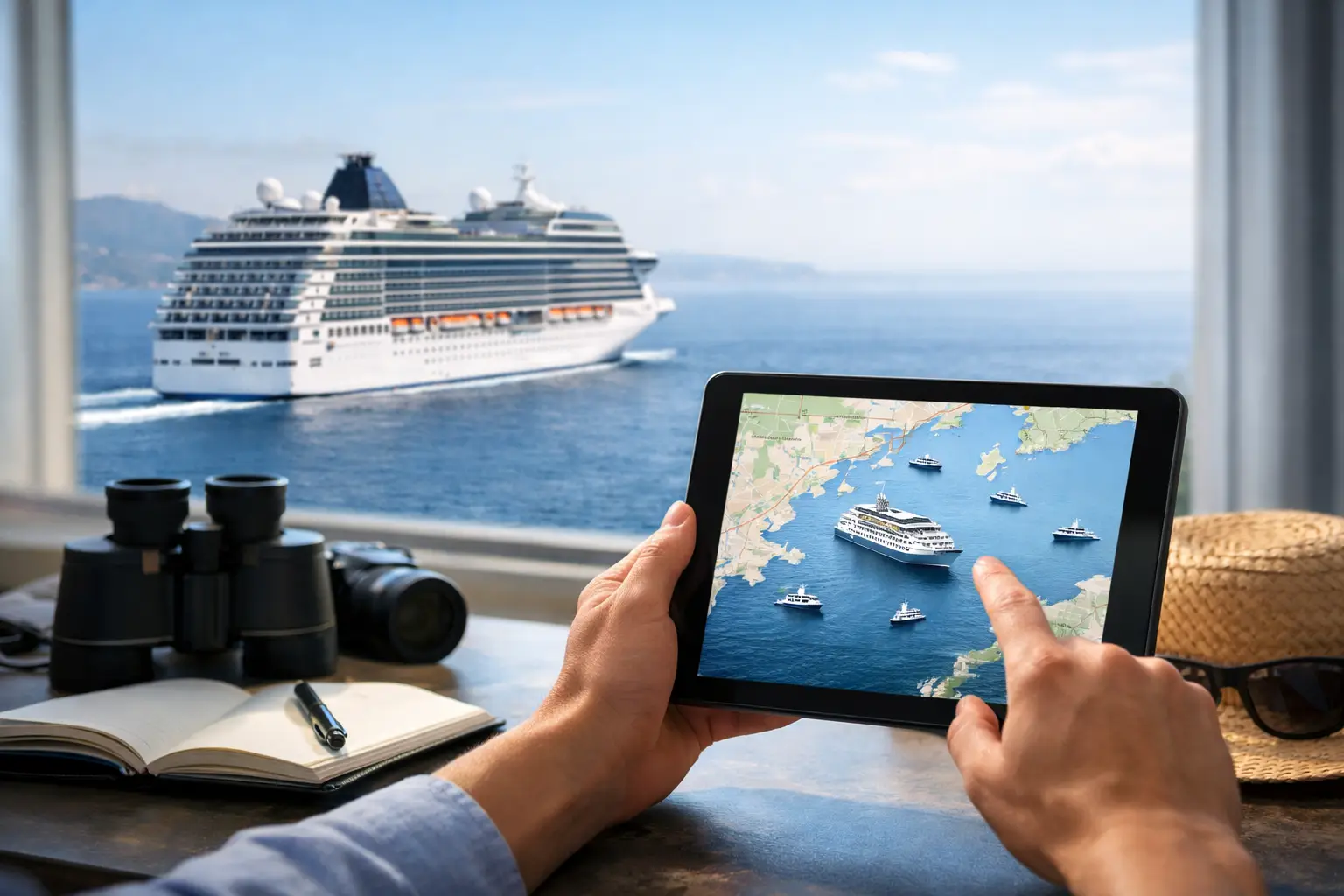
If your cruise itinerary changes by a few hours, that can affect a lot more than the ship's arrival time. It can shift your flight plans, your hotel timing, your port-day expectations, and how confident you feel about the trip overall. That is why ship tracking matters to cruise travelers. Used well, it is not just a map feature. It is a planning tool that helps you understand where a ship has been, where it is scheduled to go, and how that fits into your cruise decisions.
For cruise passengers, the value of ship tracking is practical. You are usually not trying to monitor commercial shipping patterns or study marine traffic for its own sake. You want clearer information around a specific ship, sailing, or port. Maybe you are comparing itineraries. Maybe you want to understand how a ship rotates through homeports. Maybe you are checking whether a vessel is arriving from a long repositioning route or a short turnaround in the same region. Those details can provide context that cruise line booking pages often present only in a limited way.
What ship tracking actually tells cruise travelers
At its simplest, ship tracking shows a vessel's position and movement history based on publicly available maritime data. For cruise travelers, that can help answer useful questions before booking and before departure.
You can often see a ship's recent route, its current region, its previous port calls, and its next expected stop. That helps build a fuller picture of how the ship is operating. If you are deciding between two similar sailings, it may help to know whether one ship is spending a season in the Caribbean, rotating through Europe, or transitioning between regions.
This matters because cruise planning is rarely about one isolated sailing. Ships operate within larger patterns. They shift homeports, run repeating itineraries, and move between seasonal markets. Ship tracking can make those patterns easier to understand.
It also helps set expectations. If you are sailing from a port that handles multiple cruise lines and multiple ships, seeing vessel movement in the days around your departure can make the logistics feel more concrete. That does not predict every operational detail, and it should never be treated as a guarantee. But it can give travelers a stronger sense of timing, sequence, and context.
How ship tracking helps before you book
The biggest advantage of ship tracking often comes before any payment is made. Cruise travelers tend to compare ships, itineraries, and embarkation ports in stages. During that process, tracking information can fill in gaps that standard itinerary pages do not cover.
Understanding ship deployment
A cruise line may show that a ship sails from Miami in January and from Barcelona in May. What ship tracking and movement history can help clarify is how the vessel transitions between those deployments. That can be useful if you are trying to understand whether a ship is staying in one market for a full season or moving more frequently.
For experienced cruisers, deployment patterns often shape the booking decision just as much as the itinerary itself. A ship that remains in one region for months may offer more predictable port rotations. A ship moving between markets may appeal to travelers looking for a specific seasonal route. Neither is automatically better. It depends on what kind of trip you want.
Comparing itineraries more accurately
Two seven-night cruises can look nearly identical on a booking page while operating very differently in practice. One may be part of a stable weekly loop from a long-term homeport. Another may sit inside a more complex schedule with repositioning segments or varied port sequences.
Ship tracking can help reveal that broader schedule. For travelers who care about itinerary consistency, embarkation patterns, or how a ship uses a particular port, that extra visibility is useful.
Checking port relevance
Not every traveler books based on the ship alone. Many start with a departure port or a destination region. In that case, ship tracking can be a helpful research layer when looking at which vessels call on a port regularly, which lines are active there seasonally, and how ships move through that location over time.
That is especially helpful for travelers comparing embarkation options. A port may seem convenient on paper, but understanding how ships cycle through it can add another level of clarity.
Ship tracking during cruise planning
Once you have booked, ship tracking becomes less about comparison and more about preparation. This is where it helps travelers feel more informed without turning every update into a source of stress.
Use it for context, not constant monitoring
Many cruisers make the mistake of checking ship movement too often and reading too much into small changes. A vessel's route data can be informative, but it is not the same as a final operational notice from the cruise line. Port times can shift. Routing can change. Maritime data can lag or display imperfectly.
The smartest way to use ship tracking is to treat it as one planning input among several. It can help you understand the ship's recent movements and broader schedule, but it should not replace official pre-cruise communications.
It helps with timing around embarkation and disembarkation
For travelers planning hotel stays, transfers, or flights around a cruise, movement history can offer useful perspective. If a ship typically arrives from a nearby port on a repeating route, that tells a different story than a vessel coming off a longer or more complex run.
Again, this is context rather than certainty. Cruise operations are shaped by weather, port traffic, maritime regulations, and scheduling changes. Still, context matters. Better planning often comes from understanding the likely rhythm of a ship's schedule rather than guessing.
What ship tracking does not tell you
This is where a little discipline helps. Ship tracking is valuable, but it has limits.
It does not tell you everything about the guest experience onboard. It does not confirm whether every scheduled port call will happen exactly as listed. It does not replace the cruise line's itinerary updates, boarding instructions, or official changes.
It also should not be confused with a full cruise planning solution by itself. Travelers still need clear information about ships, ports, schedules, and itinerary details presented in a cruise-focused way. Raw maritime data can be useful, but it is often built for vessel observation rather than passenger decision-making.
That is an important distinction. Cruise travelers do not just want to know where a ship is. They want to know what that movement means for their trip planning.
Why cruise-specific ship tracking matters
A generic vessel map may be enough if your interest is casual. But if you are actively researching a cruise, context matters more than motion alone.
Cruise travelers need interpretation, not just data
A ship moving between ports is one thing. Understanding how that movement connects to sailings, seasonal deployments, and embarkation choices is something else entirely. Cruise travelers benefit when tracking tools are framed around ships, itineraries, and ports in a way that supports booking and planning decisions.
That is where a cruise-focused platform has an advantage. Instead of forcing travelers to interpret marine data on their own, the better approach is to connect ship movement with the information passengers already care about - where the ship sails, how often it calls on a port, and how that fits into a real cruise plan.
VoyagePro is built around that kind of practical clarity. For cruise travelers, the goal is not more noise. It is faster access to the details that actually help.
How to use ship tracking more effectively
The best use of ship tracking starts with a clear question. Are you comparing ships in a region? Checking how a vessel rotates through a homeport? Looking at recent movement before your sailing? The answer shapes what information matters.
If you are early in the planning process, focus on patterns over moments. Look at where a ship has been operating and how its schedule fits into the season you want to travel. If you are already booked, use tracking to build context around your sailing rather than trying to treat every movement update like a prediction.
It also helps to pair tracking with port research. A ship's route makes more sense when you understand the embarkation port, the region, and the type of itinerary the vessel usually runs. That turns a moving dot on a map into something much more useful.
The real value of ship tracking for cruisers
For cruise travelers, ship tracking is most useful when it reduces uncertainty without creating false confidence. It can help you compare options more clearly, understand ship deployment more accurately, and plan around ports and schedules with better context.
That makes it a smart research tool, especially for travelers who want more than a basic itinerary page can provide. When used with the right expectations, it gives you a clearer view of how a ship fits into the trip you are planning - and that usually leads to better decisions long before you step onboard.
The best cruise planning tools do not just show movement. They help you understand what matters about it.