

If the Acropolis is the reason you want an Athens cruise stop, build the day around admission and the complete journey from your Piraeus berth. Buy the attraction ticket only after that journey works. A port call labelled Athens does not place you at the foot of the Acropolis when the ship arrives.
If you mainly want a relaxed introduction to Athens, give yourself permission to choose a neighbourhood walk, a meal and one manageable sight instead. The better day is the one you can enjoy without treating every queue or wrong turn as a threat to your return.
Choose the day before choosing the transport
| Day you want | What to organise first | What to leave out |
|---|---|---|
| Acropolis as the priority | Appropriate entry, arrival route and time to reach the entrance | A second distant attraction before admission |
| Museum-focused Athens | Museum opening and admission arrangements | A rushed climb added merely to complete a list |
| Neighbourhoods and lunch | A clear outward and return route | Multiple prepaid commitments |
| Lower-effort outing | Accessible transport and the precise walking demands | Assumptions that a famous site is easy to navigate |
These are different uses of the same port call. Trying to combine all four creates a day with several independent failure points. Choose the experience you would most regret missing, then let the rest remain optional.
Start at your actual Piraeus berth

Athens’ official Piraeus transport guide identifies two useful rail choices: Metro Line 3 to Syntagma and Line 1 to Monastiraki. It gives about 20 minutes for the Line 3 journey to Syntagma. That is station-to-station time: your berth-to-station journey and the onward walk still belong in the budget. Choose the station that suits your first stop instead of treating every Athens arrival as the same route.
Confirm where your ship is expected to berth and how passengers reach the public transport network. Ask whether there is a terminal transfer and where it drops you. A transport route that looks straightforward from the station can still involve a substantial first leg from the ship.
For taxis or prebooked vehicles, confirm the meeting point in terms the driver and terminal staff both recognise. Retain the terminal name and ship name for the return. Asking to go to “Piraeus port” is less precise than asking for the correct cruise terminal entrance.
Use the port directory to organise your research, then check the berth and passenger instructions supplied for the actual call. Treat changes as a reason to recalculate the first and last legs of your day.
Work backwards from the ship's return requirement
Use the all-aboard time communicated by the ship, not simply its advertised departure time. Set a personal return plan that leaves room for the uncertainties in your chosen route. There is no universal number of minutes that makes every independent Athens outing comfortable.
List each component: getting off the ship, reaching transport, waiting, travelling, walking to the attraction, admission, the visit itself and the return chain. Include ordinary needs such as food, water and toilets. A rail journey's advertised duration is only one part of that list.
Imagine a hypothetical call with eight hours between being able to leave and your planned return aboard. If you allocate two hours to the complete outward journey and two to the return, you have four hours for the visit, food and local movement. Those figures are an illustration, not Athens travel-time estimates. Replace them with the arrangements for your day.
| Item in your worksheet | Your confirmed or planned allowance | What could change it |
|---|---|---|
| Terminal to city transport | Fill in after identifying the berth | Terminal access and waiting |
| Journey into Athens | Use the service or provider you will take | Traffic, service changes or missed connections |
| Walk and admission | Match the actual entrance and ticket | Queues, security and walking pace |
| Main visit | Time you want to spend there | Heat, fatigue and your interests |
| Return to the ship | Include every connection and terminal leg | Disruption or a changed pickup point |
If the arithmetic only works when everything runs at its fastest, simplify the day. A shorter city visit is a stronger plan than a technically possible sequence with no usable margin.
Match the ticket to the attraction you intend to enter
Check the current official admission process before paying. Establish whether the ticket has a timed entry, which site or spaces it covers and what identification or booking confirmation is needed. A museum ticket and an archaeological-site ticket are not interchangeable simply because both relate to the Acropolis.
Choose an entry time that follows a realistic arrival, rather than buying the earliest slot and hoping to leave the ship immediately. Equally, a late slot can leave too little time to visit before returning. The ticket should fit the port day, not dictate an impossible one.
Read cancellation and change terms before adding a separate transfer or tour. If the ship misses the call, several independent purchases can have different refund rules. Keep those terms alongside each confirmation rather than assuming one cancellation protects the whole day.
If tickets are unavailable for a workable time, change the plan. A city day or an alternative attraction is preferable to paying an unfamiliar seller for an unclear promise of access.
Be honest about the physical part of the visit
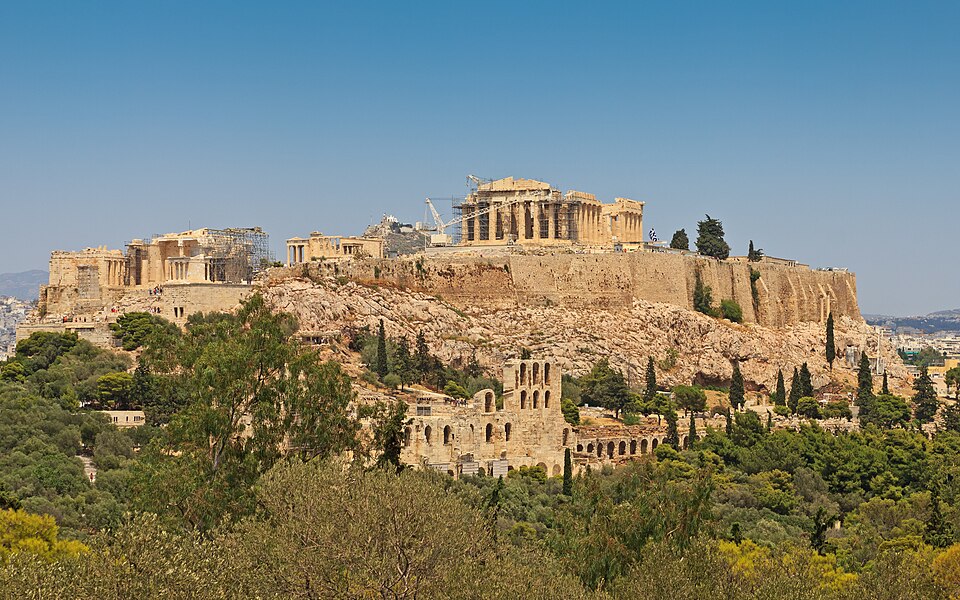
The Acropolis hilltop brings together the Parthenon, the Temple of Athena Nike and the Erechtheion with its Caryatid porch. Choose it if seeing those monuments in their setting is the priority. An indoor museum visit offers a different experience; it does not replace standing among the temples. Treat the climb, exposed areas and time standing as part of the outing, not simply a connection between transport and sightseeing.
If anyone in your party has limited mobility, ask specific questions about the route, assistance, equipment and any operational restrictions. The existence of an accessibility provision does not establish that every part of the visit will suit every visitor on every day.
Plan around the conditions on your visit date. Carry what you need within the site's rules, choose suitable footwear and allow opportunities to rest. If the physical effort would consume the group's enjoyment, a different Athens day is a legitimate choice rather than a lesser version of the holiday.
The shore-excursion activity guide provides useful questions to ask a tour operator. Request answers about this route instead of relying on a single “moderate” label.
Decide whether a tour solves your actual problem
A tour can simplify the transport and admission coordination, but read what it includes. Confirm whether the visit is inside the site or only a photo stop, whether admission is included, where the group meets and how much independent time remains.
An independent day offers more control over pace and meals, but leaves you responsible for every connection. Choose it because you are comfortable managing those connections, not because a map makes the distance look short.
Before choosing the Athens outing, read the shore-excursion comparison guide. Compare who coordinates the transfer and admission, not simply the vehicle size. If separate providers each regard a delay as someone else’s responsibility, that is a real difference from a combined booking. Keep the ticket terms alongside the transport confirmation so the whole party understands the commitment.
Before leaving the ship, save the terminal details, return route and relevant contacts offline. Agree with your companions on which optional stop you will drop first if the day runs late. That small decision protects the main experience from being crowded out by everything else you hoped to add.